
Jackson Signs Blog
How To Choose The Right Promotional Tent For Your Next Event
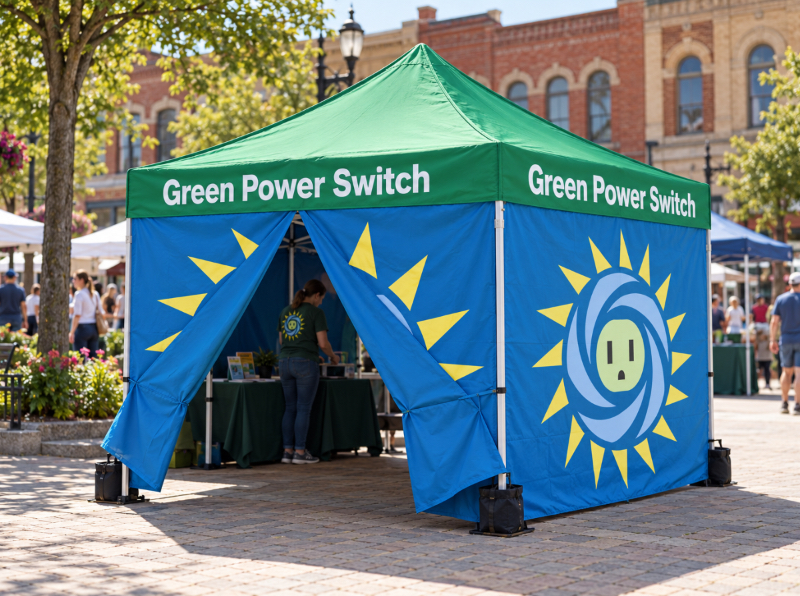 Everyone who runs a business in Brantford wants at least one custom promotional tent, so they’re equipped for event advertising, but many are not sure which design is right for them.
To help our customers choose the right tent, we’ve put this quick guide together. It explains how the main structures differ, what each one requires and the types of events where each design performs well.
A promotional tent has two jobs. It provides a defined place for your staff, products and visitors while displaying your business name where people can see it. The right structure depends on how often it will be used, how far it must travel and how much space is available at the event.
Start With How The Tent Will Be Used
It is easy to compare tents by appearance alone, but the frame and setup method will have a greater effect on daily use. A tent that works well at a weekly farmers’ market may not be suitable for a corporate hospitality area or a multi-day festival.
Before choosing a structure, confirm the following details:
- the typical event space and permitted tent size
- whether the tent will be used indoors, outdoors or in both settings
- how many people will transport and assemble it
- how often it will be set up and taken down
- whether the venue permits stakes or requires surface weights
- how much room is available for transport and storage
- which parts of the tent need printed branding
These answers make it easier to separate a practical option from one that only looks suitable in a product photograph.
The Main Types of Promotional Tents
Terms such as promotional tent, advertising tent and event tent describe how a structure is used. They do not identify how it is built. The following categories are based on genuine structural differences that affect setup, portability and the amount of usable space.
Pop-Up Canopy Tents
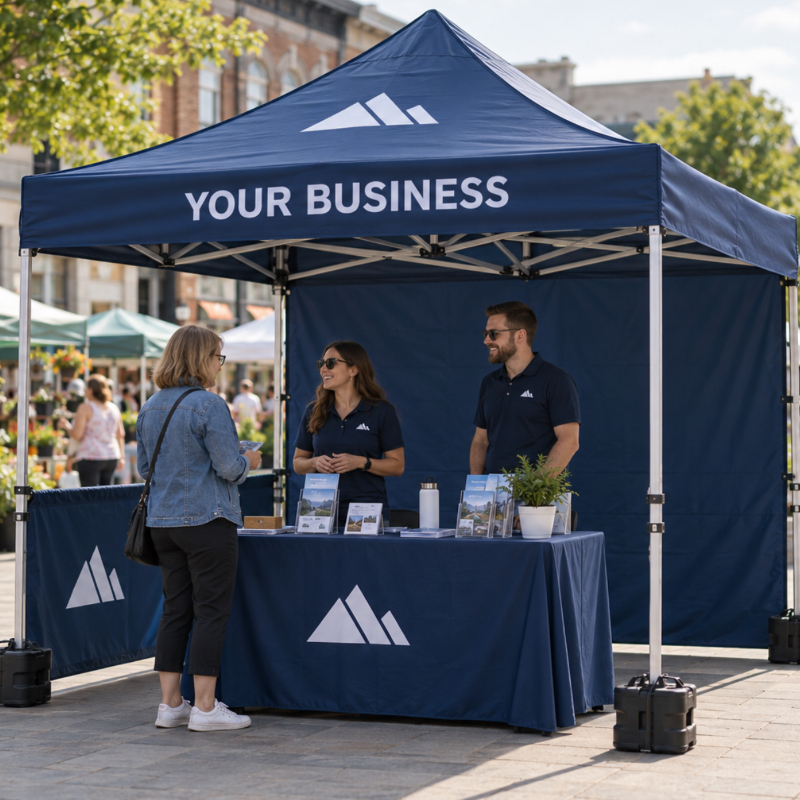 A pop-up canopy uses a folding scissor frame with telescoping legs. The frame expands as one piece, so there are fewer individual components to assemble and keep track of. The common 10-foot by 10-foot size also fits the standard booth space used by many fairs, markets and community events.
The canopy roof and valances provide clear surfaces for a business name, colours and contact information. Full walls, half walls and counters can be added when more shelter, privacy or display space is needed.
Steel frames are generally heavier and more economical, while aluminum frames are easier to move and better suited to teams that attend events regularly.
A pop-up still needs proper anchoring on every outdoor surface. Stakes may work on grass, while paved locations usually require approved weights. The tent should be closed when weather conditions exceed the manufacturer’s limits.
A pop-up canopy tent is a great choice for trade shows, farmers’ markets, job fairs, sports events and businesses that need a branded shelter they can transport regularly.
Frame and Marquee Tents
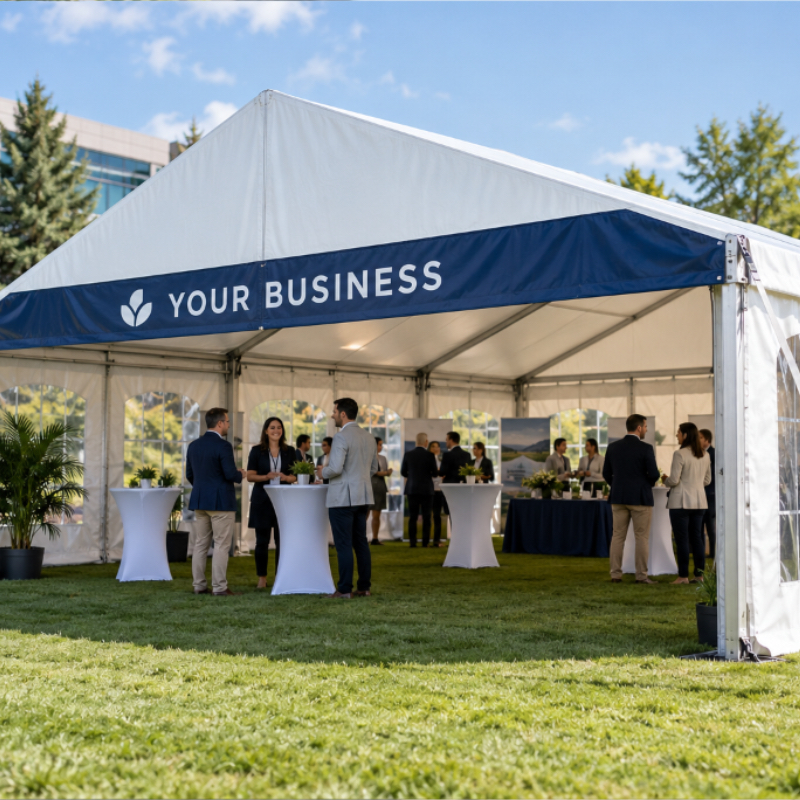 A frame tent is assembled from separate steel or aluminum tubes that support the roof. It does not normally require centre poles, which leaves the interior open for tables, displays, equipment and foot traffic. Frame tents are available in larger sizes than most pop-up canopies and can often be joined or extended to cover a wider area.
The additional space comes with more work. Components must be transported, sorted and connected, and larger models may require an experienced installation crew.
They also need a complete anchoring plan because a heavier frame does not remove the effect of wind on a large fabric roof.
Marquee is a broad term that is often used for frame tents with higher peaks, decorative roof lines or enclosed walls. When comparing products, check the actual frame design instead of relying on the word marquee alone.
Frame and marquee tents do well for corporate hospitality areas, dealership events, larger product displays and multi-day events that require clear interior space.
Star Tents
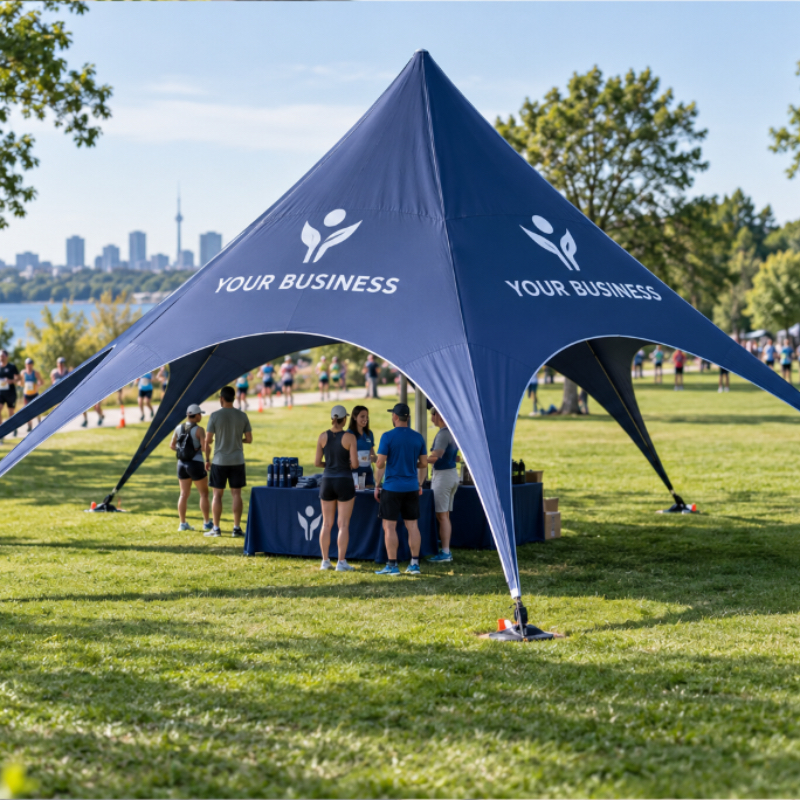 A star tent uses a central mast and several fabric points that extend outward to ground anchors. The result is a large, recognizable shape with several open entrances. Printed panels can display branding from multiple directions and help the structure act as a landmark within a large venue.
The advertised dimensions do not tell the whole story because the fabric points and anchors extend beyond the central covered area.
A star tent therefore needs a generous footprint and a site where every anchor can be installed safely. It is not usually the right choice for a standard 10-foot booth or a narrow paved location.
The open sides provide easy access, but they offer less control over wind and rain than an enclosed frame tent. Event conditions and the number of people needing shelter should be considered before relying on it as the main covered area.
A star tent does well for outdoor festivals, charity runs, sports tournaments and major sponsor areas with plenty of open ground.
What Does “PVC Frame Tent” Mean?
The phrase PVC frame tent can be confusing because it sounds as though the supporting frame is made from plastic. Most products sold under this name actually use a steel or aluminum frame with a PVC-coated fabric roof and walls.
PVC describes the covering material, while frame describes the structure. It is therefore a material-and-structure combination rather than a separate tent category. These products are commonly larger party or event tents assembled from individual frame sections. A buyer should still confirm the frame metal, fabric weight, flame-resistance documentation, waterproofing and intended frequency of use.
The same principle applies to terms such as aluminum tent, heavy-duty tent and waterproof tent. They describe a feature, but they do not explain whether the product is a pop-up, component-frame or another type of structure.
Match The Structure To The Work
For most Brantford businesses attending local fairs, trade shows and community events, a well-built pop-up canopy provides the best balance of branding, transport and setup time.
Once the structure has been selected, the next decisions are frame quality, size, printed coverage, walls and anchoring equipment. These parts can be ordered as one working system so the tent can arrive at an event ready to use.